Tuesday, July 17, 2012

Water Conservation


We are in the throws of summer. No matter where you live, summer is usually a time of increased heat and decreased water supply. In some places, government imposed water restrictions are already in place. We all love our green lawns and flower beds and if you have a vegetable garden it is necessary to water to maintain production. Have you ever thought about how much potable water we use to water our lawns and plants? Rain is better for plants, but isn't always available, so it is important that we think carefully about whether or not our water usage is necessary and make every drop count. 

When rain does occur, we should be prepared to take advantage of it. I strongly encourage you to invest in or create a rain barrel. If you already have a gutter system, it will be fairly easy to place a container below your downspout to collect water. If you do not have gutters around your house, it will be necessary for you to put up at least a few feet to channel the water in to your rain barrel. Last summer we put gutters across the back of the house to channel water into a rain barrel near our garden. It had the added benefit of helping reduce the leakage on the porch roof.


Our rain barrel is also an upcycle of a barrel that had a previous use. A quick google search will turn up several youtube videos and blogs advising you how to make your own rain barrel at home or of course, you may purchase one. 


In addition to using potable water on our lawns, we also send gallons and gallons of perfectly usable water down the drain. Showers, rinsing vegetables, waiting for the water to get hot...when I think about it too long I feel so wasteful! 

One way to help with this problem is by collecting "gray water." Gray water has been slightly used, but is still safe for things such as watering plants. We have had quite a bit of success with keeping a dish pan in one side of our sink. I use the water we collect to water the flowers inside and in the front yard.


Probably our biggest water waste is waiting for the shower to warm up. I have yet to figure out a good way to collect that water. SO many gallons of clean, good water down the drain!! We just don't have a container big enough. I welcome any suggestions. 

In school we teacher water as a renewable resource, that it goes through a cycle and renews itself. While this is basically true, the cycle requires that water be put back into the environment to continue the cycle. 


I'm not a scientist or a waste water expert, but it seems to me that water in the ecosystem is better than water down the drain. So take a watering can of gray water as you take your next...

...tiptoe through the tulips!

Saturday, May 26, 2012

"Green" vs. "Crunchy"

As I've eased my way into the world of being "green" I have discovered a new related, but different world previously unbeknownst to me - that of being "crunchy." To be honest, when I first heard the term, I did not think it sounded like something that I wanted to be! However, as I discovered blogs such as Just West of Crunchy and Crunchy Betty* I began to feel a flame growing inside of me. A flame of desire to make my whole life a little less synthetic.

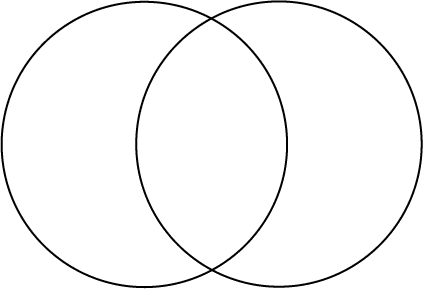
Many have the misconception that green and crunchy are interchangeable synonyms, but I view them more like a venn diagram. Some areas overlap, but they are different concepts. If you are trying to live green, you desire to be eco-friendly. This means that you want to do your best to help protect and conserve our Earth for yourself and future generations. Green actions include things like respecting nature, not littering and our favorite mantra: Reduce, Reuse, Recycle. Once living with a healthy respect for nature and the natural resources of the Earth, it is not a far leap to realize that many of the products we use and foods we consume are far from natural. In addition to being green, you may find yourself with the desire to live a "crunchy" lifestyle as well. Being crunchy is a desire to make your life more natural, and short of making everything yourself, to make choices and purchases that support companies committed to nature and more natural products.

Now, as in everything, there are degrees of crunchiness. And as with being green, it can be easy to become overwhelmed. When I first began reading and researching about living a more crunchy lifestyle, I felt overcome with the weight of all the changes I felt I needed to make. My advice on this, as I've mentioned before, is to take it slow. Find one thing that really strikes you, and take steps toward change.

For me, the first thing that really hit home was beauty products. Although I do not claim to understand the science behind these things, it makes logical sense to me that exposing ourselves to many chemicals over time would be detrimental. As our skin is quite porous and absorbent, I felt a strong desire to stop lathering myself with chemical laden products. It has been a slow process, about which I will share more in a later post, and I still have a way to go. However, for each product I replace with a more natural alternative, I feel a sense of accomplishment and well-being.

Another area that I have slowly been making changes in is cleaning products. As with the beauty products, it just makes sense to me not to spray and wash chemicals into my home. This has been a somewhat more difficult process. I am greatly hindered by my loathing of vinegar. 99% of all homemade cleaning recipes include some type of vinegar as the main ingredient. However, I have made a few discoveries which I look forward to sharing with you.

You by no means must be "crunchy" to be "green." If you desire only to do your part in helping the environment, that is wonderful! If you are interested in making your life a little more natural, more power to you. Either way, remember that you should in no way feel bad for "not doing enough." I say this as someone who has to preach that to myself on a regular basis. Sometimes it can seem like there is just so much to do and you can never do enough, short of moving to the country and living like Laura Ingalls Wilder (and the thought has crossed my mind!). Just remember the url of this blog "sneak into green." Take baby steps, make small changes and when those changes become habit, make some more changes. Remember that every bit helps and all along your journey you should...

Enjoy your tiptoe through the tulips!


*I do not necessarily endorse or agree with everything on these websites, but they were very inspiring to me so I wanted to share.

My mom and dad were conservationists before it was cool

I was raised green and didn't even know it. Back before it was in vogue, my parents were already concerned about caring for the Earth and preserving it for future generations. I was taught things like "Take only pictures, leave only footprints." On our many family hiking trips, my father went so far as to clean up after others who did not follow the same mantra. 


We learned not to be wasteful, both out of concern for the environment and out of economic frugality. We were taught to use the same cup to drink out of all day, not to run water unnecessarily and to close the refrigerator. My parents turned the A/C and heater off at night, something that drove me crazy (you could always open a window or add a blanket they said). One of the most surprising, once I was old enough to appreciate it, was the fact that my mother would wash and reuse ziplock bags and "disposable" plates, cups and utensils. 

And we recycled. Obsessively. We recycled when it was highly inconvenient, when there wasn't a recycle center in every community. We would load up our tubs of recycling into the car and drive quite a ways to drop it off. My father, meticulous as he is in everything, taught me to rinse things out and sort them thoroughly into the tubs in the garage. He was also the person who would reach into the bins at the recycling center and reorganize items that others had dumped into the wrong place.

Many of these things followed me into my adult life, as things learned in childhood often do. I was somewhat surprised that not everyone was concerned with caring for the Earth, that not everyone wanted to find ways to not be wasteful. Of course, as most young adults will do, I chose to impress my friends rather than stick with my training. Although, when they weren't looking, I would often pick up trash they left behind. ;-)

Once I became a "responsible adult" many of the old habits began resurfacing. When I was first married, I tried washing ziplock bags (my husband thought I was crazy). I have become lazy in more recent years, but have been thinking about starting again. Since having a household of my own, recycling has been a part of it. When we still had our small apartment, it was somewhat of a challenge to find room for recycling bins, so we recycled only the basics. Now that we have a house, we have plenty of room to organize our recycling without having to take it to the recycling center every week (we purchased even bigger bins since my previous post). I still rinse everything out before putting it in the bins. 


The more I think about it, the more I realize it is not a big surprised that I am on a journey to become more eco-friendly and earth conscious. After all, being green is something that was instilled in me since childhood! Thanks mom and dad for teaching me to 


Enjoy my tiptoe through the tulips!

Wednesday, February 8, 2012

Don't use that tree to wipe your face!

Do you remember going to your grandmother's house for a special occasion, when she would use the fancy place settings, including the cloth napkins? Or perhaps you've very politely placed your cloth napkin in your lap at a nice restaurant. For some reason, cloth napkins have always been associated with fancy situations or special occasions. On normal days, disposable, paper napkins are used in most households.

But why? A dear friend of mine kindly pointed out to me that there isn't really any reason not to use cloth everyday, other than perhaps, not having any! This seemed like sueh a simple and fun way to reduce the use of paper products in our house.

My first step, was to reassign a set of washcloths to the job of napkin. This particular set had been given to me as a gift and yet didn't match either my bathroom or my kitchen, and therefore had not been used much. The only drawback to using these as napkins we found is that there weren't very many of them and we ran out quickly.

The same dear friend promised to teach me how to sew my own washcloths. When I was a teenager, my mother taught me to sew, but I haven't done much more than look at a sewing machine since then. However, my friend assured me that it would be super simple, so we moved forward with the project.

The first step was to purchase my fabric. I bought terrycloth for one side and flannel prints for the the other side.

Here are my fabric purchases:
The first batch I cut rather large, thinking about the size of a paper towel.
I was HORRIBLE about cutting the fabric the same size,
but felt better when my friend let me use fancy stitches.

You'll notice that one of them had to be stitched twice...
on some of them I got too close to the edge and had to stitch again. :)

After making a few with my friend's fancy machine,
I came home to finish sewing the fabric.
I discovered that my own machine can do a few fancy stitches.
I chose to use the loopy loop to match the dots.

The second batch I cut really small.
I was much better at sewing straight by this point,
but as you can see, still not good at cutting them the same size!

So far we have loved using the cloth. I was so proud of them that I didn't want to use them for really gross clean-up jobs and still used paper towels some. I have been less picky since then, but we keep paper towels around "just in case." Perhaps I am just too chicken to rely completely on cloth, but I comfort myself knowing that we usually compost the paper towels, so at least they aren't filling up a landfill somewhere.

Look around your house and see if there are some disposable products that can fairly easily be replaced with reusable ones. I would love to hear your ideas. Until then...

Enjoy your tiptoe through the tulips!
Posted by Picasa

Tuesday, July 26, 2011

Conserve or Reduce?

This post has been waiting for me to publish it for...months! Enjoy...

Conserve: to use or manage (natural resources) wisely; preserve; save:Conserve the woodlands.


Remember that post about reducing our use of resources and the waste that we produce? How is reduce different from conserve? My poor fifth graders get confused about this every year. Is there a difference?

My easiest teacher explaination is that conserve is like save. Instead of spending all of your money, save some. Instead of using all your resources, save some. Don't cut down all the trees, use up all the water, consume all the petroleum etc. So in a sense, if you reduce your use of resources, you are conserving them for the future.

It is only a matter of semantics of course. In the end, all that matter is that we are doing what we can to save the earth.

So how can we conserve? What can we really do to effect the rapid depletion of natural resources?

One way is to use less in your own home. Reduce your consumption of water, electricity, wood, paper, plastic etc. The biggest benefit of conserving resources in your home is that you can feel better about not contributing to the depletion of our natural resources. In addition, choosing products wisely can send a message to corporations that conservation of resources is important to you. Even if you don't have the time or passion to get involved in petitions, political debates, etc., be assured that your consumer choices do send a message. Choose products with less packaging. Buy products and support companies that have reduced their consumption of resources and/or are committed to renewable practices. If you don't have time to do the research yourself, there are few organizations that help you recognize such products.

One that we have recently become excited about is the Rainforest Alliance. We have been buying fruit (especially grapes) and coffee with their green frog symbol when possible. Companies with this certification use sustainable land use practices, allowing for farmers to continue to grow their cash crop, but in a way that minimizes negative impact on the environment.

There are a couple of other things we are doing around our house to reduce and conserve. I have placed dishpans near all faucets to collect extra water. We waste a great deal of water waiting for the temperature to change (our water heater is SOOO slow!). In addition, some items that need to be rinsed, aren't really contaminating the water and it can be reused. We are not using this collected water for drinking. Instead, we have been using it to water our flower beds and porch plants. I have found that when we are consistent with our water collection in the sinks, we have plenty of water to share with the plants without having to turn on the outside hose.

Another way to conserve water is buy using a rain barrel. Now, I know you are probably laughing since we have been experiencing an extreme drought for over a year. However, I think this is all the more reason to have a rain barrel. On the few occasions when water does fall from the sky, why not save some for later? Jeremy made the rain barrel below and we installed guttering on the back of the house to help collect water.


While these collection methods have not entirely eliminated our use of potable water for household and garden needs, every little bit helps as we...

...tiptoe through the tulips!

Sunday, July 24, 2011

Getting Started: Reuse

Reuse is the part of the "Reduce, Reuse, Recycle" mantra that I am most excited about right now. One day recently I was looking at all our recyclables and I thought, "There has got to be SOMETHING I can do with all this stuff!"
I posted the following picture on facebook and got some helpful and not so helpful advice (from my husband, ahm :)
  • Brandie Neal Pinterest!
    June 29 at 2:38pm · · 1 person
  • Kaia Aline Flowers Save them for when we make cleaning products
    June 29 at 2:46pm · · 1 person
  • Jeremy Pierce We can use them to remind us to buy more food.
    June 29 at 2:57pm · · 1 person
  • Vicki Welch Cunningham Recycle and get the inevitable done
    June 29 at 3:29pm ·
  • Amanda Pierce Thanks guys! We do recycle, which is why they aren't in the trash (our recycle bin is full right now). Even that seems like a waste sometimes with such interesting containers!
    June 29 at 3:31pm · · 1 person
  • Amanda Pierce Kaia, I will definintely save the bigger ones for that.
    June 29 at 3:31pm ·
  • Brandie Neal Hey, the order is Reduce, Reuse, Recycle, so you are on the right track. :D
    June 29 at 3:56pm ·
  • Shannon Finley If you know any one who works with small children some of them can be used to make instruments and things!
    June 29 at 5:34pm ·

  • Kaia Aline Flowers we could probably use all of them


So many possibilities! Unfortunately I couldn't find uses for all the containers pictured above and most of them were recycled, but I did save a few. The containers below are waiting to be used for several things: water collection, eco-friendly cleaner storage, and gifts (shhh!)

Reuse is very closely related to reduce. The more items you reuse, the less new items you will have to buy! Consider a reusable water bottle that can replace hundreds of plastic bottles.

As I said, I'm just getting started with the whole reuse thing, so I don't have tons of advice to offer in this area. I would love to hear any ideas that you have!

Also, you may have noticed a mention of "pinterest" in the facebook comments. If you have not discovered pinterest.com you totally should! It is a great forum for the sharing of ideas and many people on there are interested in do it yourself projects. The few ideas I do have for the containers came from things I saw on pinterest. I look forward to sharing with you the projects I come up with. Until then...

Enjoy your tiptoe through the tulips!

Getting Started: Reduce

I don't think it is any mistake that "Reduce" is first in the mantra. Perhaps it is just a matter of making things sound good, but I tend to believe it is because it is actually probably the most important thing we can do to help our environment. Why are so many things made with synthetic materials that don't biodegrade? Why do companies continually rape the planet of it's resources faster than nature can reproduce? Because we buy it. Because we want it. Because we use it without thinking about it.

While I believe reduce is the most important, it is also the one I struggle with the most. I have been especially troubled by our use of plastic. Plastic is probably one of the miracles of our modern science. It has allowed us to have and do MANY that we take for granted in our daily lives. Unfortunately it is probably the thing we use in our daily life that is the worst for the environment. As discussed in my last post, we can recycle plastic. However, the information on how effective that recycling is, is sketchy.

All in all, the BEST way to reduce our impact on the environment is to reduce our consumption and our waste. Unfortunately I have not had an overwhelming amount of success in this area. I feel as if I am just chipping away without making much progress.

That being said, there is one big way to reduce your use of plastic, specifically plastic bags. Reusable bags! Not only are they useful, and good for the environment, they can also be pretty! Even if you use ones made of plastic, using them over and over instead of throwing bags away after each shopping trip will reduce your personal impact on the environment.

Some bags are plain, but useful.


Insulated bags are extremely useful!


They can also be pretty!
These are some of my favorites :D


You're bags can also make a statement.
(Just for clarification, music is not life for me,
it is just the reusable bag that was available at HotTopic)

If you have other ideas for how to reduce our use of materials, or our general impact on the environment. In the meantime...

Enjoy your tiptoe through the tulips!